
Warning: Do Not Travel — The Project 2025 Chronicles, Vol. II
A blueprint becomes a government at blinding speed — I spent eleven years inside the systems it’s taking apart.


They wrote the blueprint. He said he’d never heard of it. Many now hold the most powerful positions in the U.S. government.
Donald Trump spent the 2024 campaign insisting Project 2025 had nothing to do with him. Less than two years later, its authors, contributors, allies, and ideas have reshaped the immigration system in ways that just a few years ago would have seemed unimaginable.
Volume I of The Project 2025 Chronicles traced the blueprint and the people now carrying it out. Volume II follows one piece of that blueprint from first-term asylum policy to a plane that has now landed in Bangui.
VOL II — Warning: Do Not Travel
The State Department issues a Level 4 advisory for the Central African Republic:
Do Not Travel — for any reason.
Not “reconsider travel.” Not “exercise increased caution.”
Americans are warned of unrest, crime, kidnapping, landmines, terrorism, and health risks. The advisory says the U.S. government has limited ability to help its own citizens there. Its own employees need special authorization to leave Bangui, travel in armored vehicles inside the capital, and live under curfew. Their family members cannot join them.
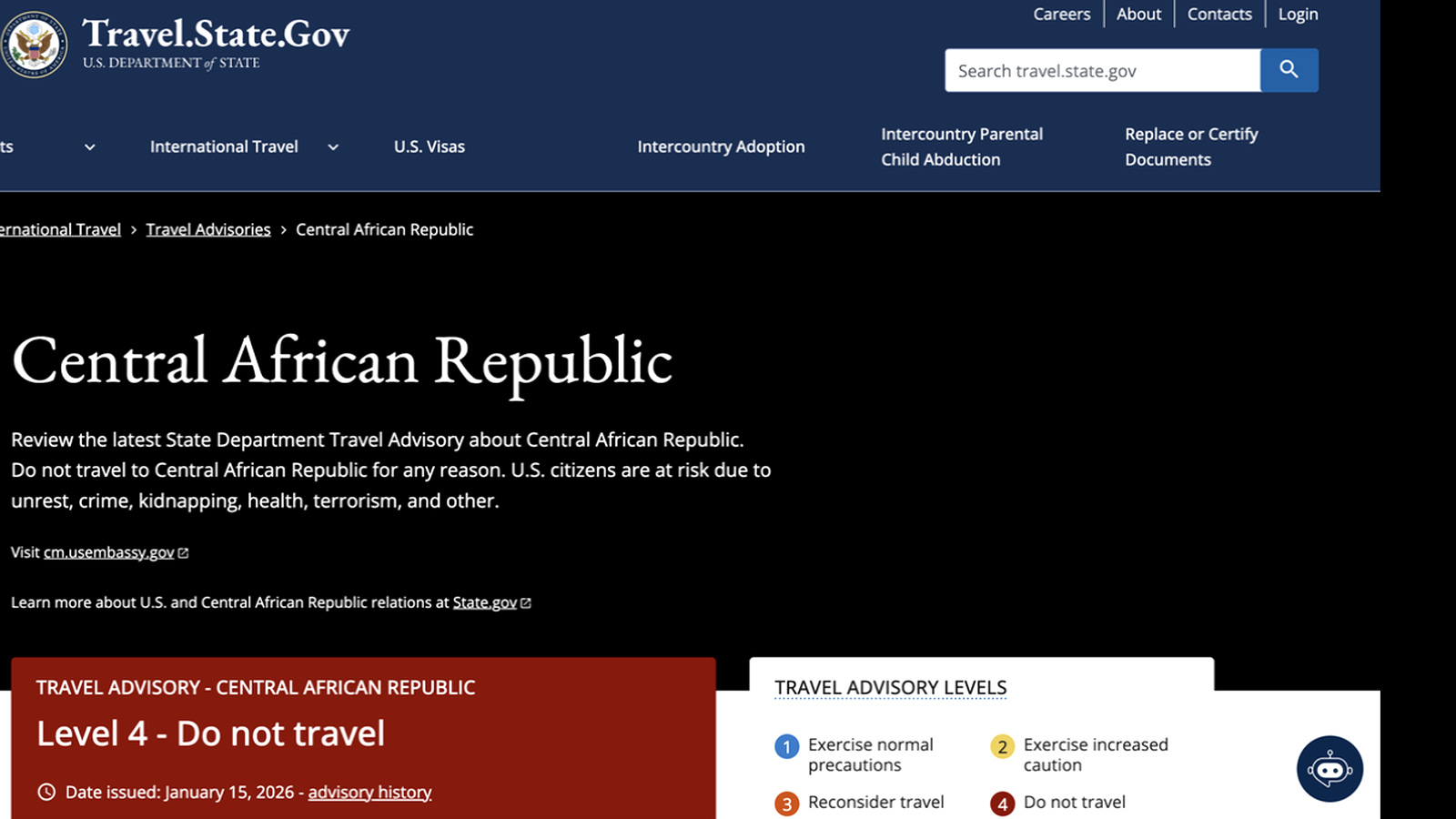
The Central African Republic is under a Level 4: Do Not Travel advisory.
For Americans who go anyway, the government’s advice reads less like travel guidance than preparing its citizens to go missing: draft a will, designate power of attorney, leave DNA samples for identification, and establish a proof-of-life protocol with loved ones in case hostage-takers need to be questioned.
Last Friday, the United States deported people to that country.
Not the “worst of the worst,” if that’s what you were told. About twenty people who fled Afghanistan, Iran, and other countries came here seeking protection — and, in some cases, won it. They were granted protection by a United States immigration judge.
A grant of protection is not a courtesy. It is a legal finding by a judge that returning a person to persecution or torture would be illegal.
This flight set that judge’s order on fire.
More precisely, it exploited the gap between a court order barring removal to one country and a system now willing to send people to some of the most dangerous places on earth. It circumvents the foundation of refugee law — the principle of non-refoulement, which bars sending people to any country where they would likely face persecution or torture.
Rather than honor a court order protecting someone from that fate, the administration finds another country willing to take them instead.
The architecture was built in the first Trump term under Stephen Miller, then a White House adviser: Remain in Mexico, which forced asylum seekers to wait out their cases across the border in areas controlled by cartels and gangs; and the Asylum Cooperative Agreements with Guatemala, Honduras, and El Salvador, which allowed the United States to send asylum seekers to countries already struggling with violence, displacement, and asylum systems that were either incapable of meaningful protection or barely functioning in practice.
We challenged that architecture at the time. As a union steward, I wrote publicly in 2020 about how those policies were forcing the refugee and asylum system to abandon the very protection principles it was built to uphold.
Even those policies carried the pretense of process. Under Remain in Mexico, the government relied on arcane “contiguous territory” language and built a fear-screening mechanism around it. Under the asylum agreements, there was at least the formal claim that another country would hear the case.
That pretense is gone.
The new model is simpler: put people on a plane.
We saw it with CECOT, when the United States sent Venezuelans — most with no criminal record — to a notorious Salvadoran mega-prison built for gangs. We saw it with South Sudan, when men from other countries were flown toward a country facing famine and on the brink of civil war. We saw it with the Democratic Republic of the Congo (DRC), where the United States sent people with no connection to one of the largest refugee-producing countries on earth.
Now it is the Central African Republic (CAR).
Project 2025 did not invent the architecture. In its DHS chapter, under “Asylum Cooperative Agreements,” it took the first-term prototype Miller helped build and tried to lock it into place. It urged Congress to mandate that the executive branch “work faithfully to negotiate and execute ACAs” and ensure that an unwilling future executive could not “renege on an existing agreement or abandon the effort.”
Third-country removal would no longer be a temporary deterrence measure. It would become a durable feature of American immigration policy.
Between administrations, Miller’s organization was tied to the Project 2025 network. Now he is the White House Deputy Chief of Staff. The third countries are no longer Guatemala and Honduras. They are El Salvador’s CECOT, South Sudan, the DRC, and now the Central African Republic.
This is the blueprint becoming government.
It is a plane that has landed in Bangui.
But the runway was built long before this flight. The old model still had a legal theory, however strained, and a process, however hollow. This one is the prototype on steroids: more countries, more money, more secrecy, and almost no rule of law in sight.
Start with the office.
The Office
In 2025, the State Department reorganized. Folded into a hundred-page plan sent to Congress was a new unit: the Office of Remigration.
The word is not bureaucratic boilerplate. “Remigration” is a term from the European far right — Germany’s AfD, Austria’s Freedom Party — for the forced removal of immigrants. The administration chose it deliberately. In an emailed statement to WIRED, the State Department put it this way:
“Remigration puts these words into action.”
Here is the part to sit with. The office was placed inside the Bureau of Population, Refugees, and Migration — PRM — the State Department bureau Congress made central to the U.S. refugee resettlement system.
Since 1980, that system has resettled more than three million refugees from around the world. PRM is the nerve center of that work: coordinating with international organizations, resettlement agencies, and foreign governments; building the overseas pipeline; and making sure the cases and infrastructure are in place before USCIS refugee officers arrive to interview applicants and decide who qualifies for protection.
That is the bureau where the administration built an office for remigration.
The same reorganization eliminated the division that resettled Afghans who had worked alongside American forces.
And now, from inside the same bureau, the government is facilitating deals to send Afghans, Iranians, and others to countries like the Democratic Republic of the Congo and the Central African Republic — places where they have no status, no connection, and where our own government tells Americans to draft a will before entering.
Inside the bureau built to move refugees toward safety, the administration built an office to move protected people into grave danger.
The Destinations
The Central African Republic is not the first stop. Since early 2025, the United States has signed third-country deportation agreements with more than thirty nations — including the Democratic Republic of the Congo, Ghana, Sierra Leone, Equatorial Guinea, and now CAR. More than $44 million in taxpayer money has gone to receiving governments, tracked by Human Rights First and Refugees International.
As the first deportees arrived in Kinshasa, I wrote about the moral and legal inversion of sending people with no connection to the DRC into one of the largest refugee-producing countries in the world. On that flight was Adriana Zapata, a Colombian woman a judge had found, in February 2025, more likely than not to be tortured if returned.
The United States sent her to the DRC anyway.
Less than two years ago, I spent over a month in Tanzania supervising refugee processing of applicants from the DRC — villages burned, families killed, systematic sexual violence. These were the kinds of claims the refugee system was built to assess: people fleeing exactly the type of violence and persecution the law is supposed to recognize.
Now the United States is sending people who won protection in court to countries that put them at grave risk.
And the danger is not theoretical. People sent to Equatorial Guinea and Cameroon — countries with serious human rights concerns of their own — have been detained on arrival and sent onward, back to the countries they fled.
Refoulement with a layover.
What the governments on the receiving end were promised, we do not fully know. The agreements are secret. Congress has asked for them and been refused.
What is on the record: the Central African Republic agreed to accept third-country deportees under a secret arrangement; the United States awarded $85 million to IOM for operations in that same country; CAR is rich in minerals — especially in diamonds and gold, resources long entangled with conflict, corruption, and armed groups.
In the DRC, the deportation agreement sits beside a signed deal granting American companies preferential access to critical minerals.
Three facts, on the record, side by side.
The Law
On paper, at least, the law is not ambiguous.
Many of the people on these flights have withholding of removal. It is a judge’s order carrying a specific finding: that returning the person to their home country would more likely than not result in persecution or torture. It does not grant permanent status; it bars removal to that country.
The government’s workaround is that the order bars only that one country — so it ships them to a third country instead, even one that may be dangerous for them, or that may turn around and send them back to the place they fled.
Consider the case that set this litigation in motion. A gay man from Guatemala, granted withholding of removal because a judge found he would likely be tortured there, was put on a bus to Mexico two days later, with no notice. Mexico sent him back to Guatemala, where he went into hiding.
He had a court order protecting him from exactly that outcome.
The government found a way around it.
In D.V.D. v. DHS, a federal judge in Massachusetts barred the government from deporting people to third countries without notice and a meaningful chance to say they would be harmed there. The government tried to deport a group toward South Sudan in violation of the order; the men ended up held in a converted shipping container at a U.S. naval base in Djibouti.
In June, the Supreme Court stayed that injunction without explanation. Justice Sotomayor, joined by Justices Kagan and Jackson, dissented.
“In matters of life and death, it is best to proceed with caution. In this case, the Government took the opposite approach.”
She wrote that the Court was granting emergency relief from an order the government had “repeatedly defied.”
Through every stage of it, the flights kept leaving.
That is the pattern. The law exists on paper. The process moves faster than review. The plane leaves before the court can catch it.
The pillar beneath the entire refugee system is supposed to be simple, and it does not depend on having won a court order: the United States does not send people to persecution or torture. It is the core premise of the 1951 Refugee Convention and the Refugee Act of 1980.
Not directly.
Not by laundering the removal through another country.
Not by handing someone to a government that may detain them indefinitely, abandon them without status, or send them onward to the place they fled.
This is the logic pushed to its endpoint: not turning people away before they can apply, but expelling people to some of the most dangerous places in the world after they made it through, were vetted, received hearings, and, in some cases, won.
The vetting happened. The hearings happened. The protection was granted.
That is not enforcement.
That is the protection system running in reverse.
And it is sending people to countries where our own government warns Americans to draft a will and leave DNA samples for identification before entering.