
The Refugee Officer Was on the List: The Project 2025 Chronicles, Vol. I
A blueprint becomes a government at blinding speed — I spent eleven years inside the systems it's taking apart.


They wrote the blueprint. He said he’d never heard of it. Many now hold the most powerful positions in the U.S. government.
Volume I: The Refugee Officer Was on the List
During the 2024 presidential campaign, Donald Trump insisted Project 2025 had nothing to do with him.
“I know nothing about Project 2025. I have no idea who is behind it,” he wrote in July. At the September debate, he repeated the denial: “I have nothing to do with Project 2025. I haven’t read it. I don’t want to read it purposely.”
But he apparently knew enough about it to call parts of it “absolutely ridiculous and abysmal,” the product of the “radical right,” and “seriously extreme.”
On that last point, I’d have to agree.
Project 2025 was not a typical think-tank policy paper. It was a governing blueprint designed precisely for a second Trump administration: a detailed plan to restructure the federal government, concentrate power in the executive branch, bring the career civil service to heel, crush federal unions, and place the machinery of government under direct political control.1
And its architects are not still roaming the halls of Heritage, the Federalist Society, or America First Legal, writing their next policy paper.
Some wrote chapters. Some edited the volume. Some built the personnel machinery. Some supplied the immigration agenda.
Now many of its authors, contributors, allies, and implementers are operating from inside the executive branch.
Russell Vought, a principal architect of Project 2025, authored its chapter on presidential power and now runs the Office of Management and Budget — the office at the center of the federal budget, personnel, and agency control. Stephen Miller’s America First Legal was part of Project 2025’s advisory network, and Miller has been at the center of White House immigration policy across both Trump administrations. Joseph Edlow contributed to Project 2025 and now runs USCIS. Tom Homan, a former acting ICE director, Heritage Foundation fellow, and Project 2025 contributor, is helping drive the administration’s deportation agenda from inside the White House.
Others built the blueprint itself. Paul Dans directed Project 2025. Kevin Roberts led Heritage and wrote its foreword.
It is difficult to argue otherwise: Project 2025 became exactly that — the governing blueprint for this administration.
The result has been the most significant transformation of the federal government in generations.
It reached the agencies that deliver foreign aid, administer federal law enforcement, protect public health, regulate markets, enforce labor laws, manage public lands, process benefits, and carry out the daily work most Americans only notice when it stops working.
Large portions of the federal workforce have been reclassified. Collective bargaining rights have been gutted. Agencies have been reorganized. Thousands of subject-matter experts have been fired, pushed out, or walked out the door. The immigration system has been rewritten.
DOGE served as the accelerant: a team of Elon Musk-aligned tech operatives embedded across agencies in the name of efficiency, with free rein to cut staff, access sensitive data systems, dismantle offices, and force changes at a speed impossible under ordinary legal, regulatory, and civil-service constraints.
The goal was not subtle. Vought once explained the objective this way: “We want the bureaucrats to be traumatically affected.” Not an especially reassuring message from the man about to become the de facto head of human resources for the entire federal workforce.
For me, and for hundreds of thousands of civil servants, it started with an email.
In late January 2025, federal employees across the government received a message with the subject line: “Fork in the Road.”
Many employees ignored it at first. It came from an unfamiliar email address and looked enough like a phishing attempt that people spent the day asking whether it was real.
It was.
The message was presented as a voluntary resignation offer. But even the first email carried the threat underneath it: take the deal now, or remain inside a government openly warning that your job, your agency, and the protections around both were in peril.
The messages that followed only made the point clearer. This was not normal HR communication. It was a repudiation of public service itself: a message to hundreds of thousands of career civil servants saying they were no longer wanted, no longer needed, no longer trusted, and should consider getting out before the machinery moved against them.
That was the beginning of the trauma Vought had described.
Not metaphorically. Institutionally.
One of the positions identified for reclassification under Project 2025’s workforce vision was Supervisory Refugee Officer.
That was my job.
This series examines how a policy blueprint becomes government: the document, the people, the implementation, and the impact.
It focuses on the parts of Project 2025 now dismantling the systems where I spent eleven years in public service: immigration, refugees, asylum, USCIS, and the federal workforce that carries those systems out.
The changes have come at a blinding pace: civil service, federal unions, refugee admissions, asylum adjudications, immigration benefits, agency staffing, and enforcement priorities. One executive order after another. One memo after another. One court challenge after another.
Viewed individually, they can seem disconnected.
Viewed together, they reveal a governing strategy clearly outlined in Project 2025.
Each installment will track three areas where that strategy is now visible: the federal workforce, the refugee program, and the immigration and asylum systems.
The List
Last week, the administration finalized what was once known as Schedule F, creating a new employment category called Schedule Policy/Career and identifying roughly 8,000 federal positions for conversion.
For most Americans, that sentence means very little.
In practice, it means thousands of career civil servants who were previously protected from political dismissal can now be removed far more easily by the administration they serve.
For more than a century, the federal government has generally operated on a distinction between political appointees and career civil servants.
Political appointees are expected to advance the president’s agenda. Career civil servants are expected to carry out lawful policy regardless of which party occupies the White House.
That distinction exists for a reason.
Without it, every change in administration risks becoming a spoils system in which loyalty to political leaders matters more than expertise, institutional knowledge, professional judgment, or the Constitution itself.
That may sound strange to people in the private sector, where at-will employment is often treated as normal. But civil-service protections are not a perk. They are a guardrail. Career employees have never sworn an oath to a president. They swear an oath to the Constitution. Those protections exist so they can apply law, report misconduct, resist unlawful pressure, and serve the public rather than whoever happens to hold political power.
The administration argues these changes are necessary to improve accountability and ensure that federal employees faithfully carry out presidential priorities. The premise beneath that argument is familiar: career civil servants are not neutral professionals but an entrenched bureaucracy, a “deep state,” or a politically biased obstacle to the elected president.
In eleven years in the USCIS Refugee and Asylum divisions under four administrations, I never saw a career employee refuse to carry out a lawful policy directive because of personal political views.
I worked alongside conservatives, liberals, and everything in between. Most people kept their politics to themselves. Federal employees are subject to Hatch Act restrictions, and managers are trained to take those obligations seriously.
As a supervisor and union representative, I dealt with employee misconduct issues, performance issues, workplace disputes, and disciplinary matters. I represented colleagues whose politics I knew or could guess. It never mattered. The question was whether management had followed the law, the contract, and the evidence.
Political beliefs were rarely the issue. Federal employees swear an oath to the Constitution, are restricted in partisan political activity, and can face serious discipline if they cross those lines — which is one reason, in my experience, most civil servants kept their politics out of the work.
The rule finalized last week did not appear out of nowhere. Trump tried to create a version of this system at the end of his first term, but it never fully took effect before he left office. In February, the administration finalized the framework again: up to 50,000 career employees could be moved into a new category of at-will employment, with reduced appeal rights and whistleblower complaints handled inside agencies rather than through the independent Office of Special Counsel. Last week’s list showed the first roughly 8,000 positions selected for conversion.
Then I opened the list.
Buried among thousands of positions was one entry that caught my attention:
Supervisory Refugee Officer.
It was the position I held when I left federal service less than a year ago.
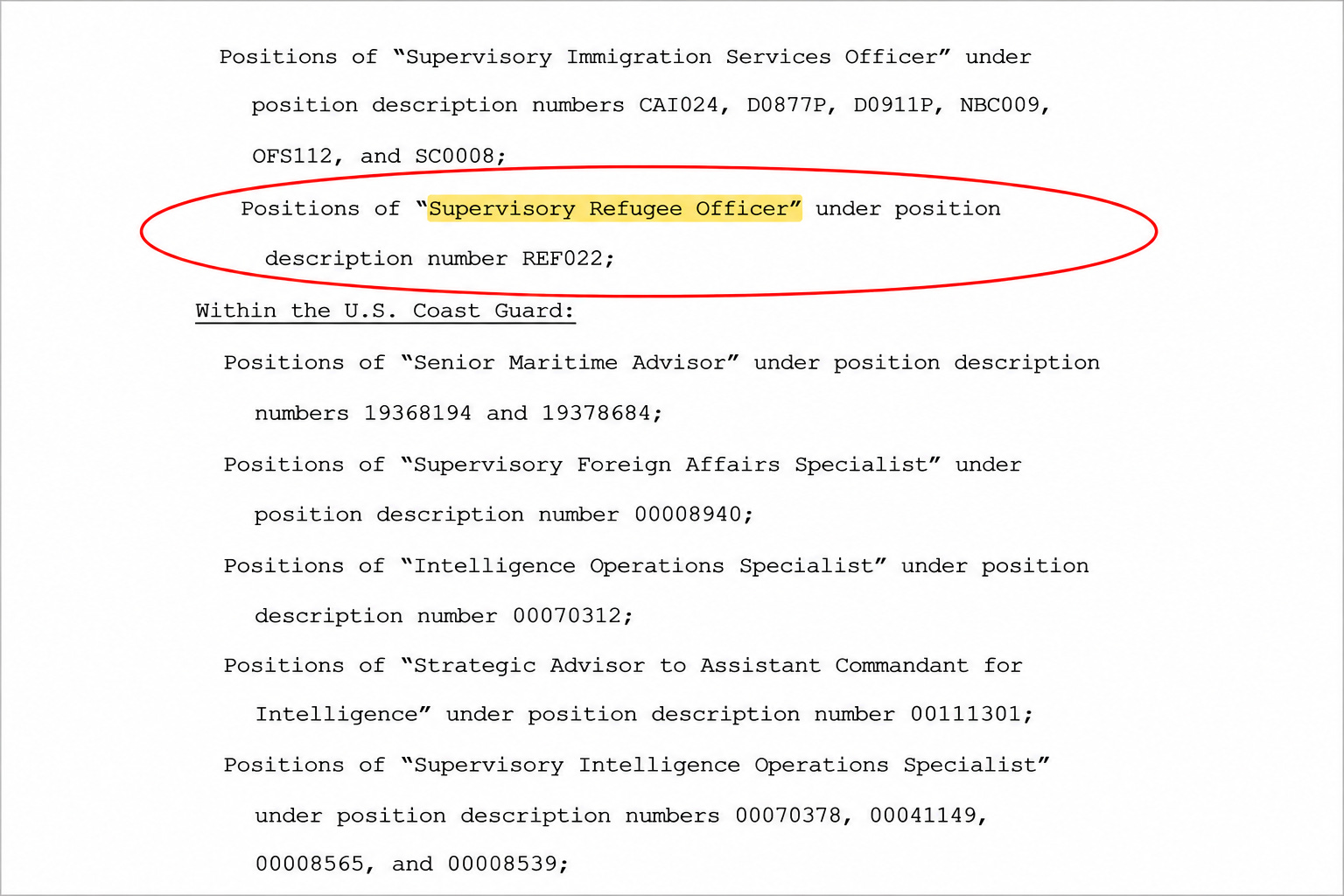
Appendix to the administration’s Schedule Policy/Career conversion list identifying “Supervisory Refugee Officer” positions for reclassification.
The reclassification list was not the only move aimed at the federal workforce. The administration had already moved to treat broad categories of federal employees as tied to national security, stripping collective bargaining rights from workers whose jobs had never meaningfully changed. As a result, thousands of civil servants were stripped of those rights, while some unions were left with few — or no — employees remaining in the bargaining units they were supposed to represent.
The logic was the same: strip the protections that make career public service possible and pull more of the federal workforce under presidential control.
Project 2025 laid it all out — reclassify policy-adjacent employees so they can be removed more easily, break federal unions, and lean on the unitary executive theory to concentrate the civil service under the president. That theory holds that the president should command the entire executive branch directly: every official wielding executive power answers to him, and the independent agencies, career protections, and internal checks built up over a century are unconstitutional limits on his authority. Pushed to its limit, it is a theory of nearly unchecked executive power.
But what exactly is a Supervisory Refugee Officer?
And why would it be on this list?
I spent eleven years in USCIS’s Refugee and Asylum divisions. For part of that time, I served as a Supervisory Refugee Officer — managing officers responsible for interviewing and vetting refugee applicants, applying U.S. immigration law, and signing off on decisions about who would be admitted to the United States.
It is not a political position. It’s not even a policy one.
No president appoints it. No Senate confirms it. No administration arrives and fills it with loyalists.
It is a career civil-service position built around expertise, training, and the application of law and policy regardless of which party occupies the White House.
Which raises an obvious question.
Why was it on the list?
The Refugee Program
This week also brought two reminders of what has happened in less than eighteen months to U.S.R.A.P. — a crown jewel of humanitarian protection systems. Of the roughly four million refugees resettled worldwide since 1980, approximately three million came to the United States. For decades, the United States resettled more refugees than the rest of the world combined.
In fiscal year 2024, the United States admitted roughly 100,000 refugees from around the world. In January 2025, the new administration suspended refugee admissions, dismantled much of the resettlement infrastructure, and put Stephen Miller’s immigration agenda back at the center of the White House.
For the sixth consecutive month, the United States has admitted only white South African refugees. The administration cited an “emergency” to resettle 10,000 more white Afrikaners while already-vetted Afghan allies, Sudanese, Burmese, and nearly every other refugee population are shut out.

Afrikaner refugees arrive at Dulles International Airport on May 12, 2025, where they were greeted by senior State Department and DHS officials.
The overlap was not subtle: the same administration that empowered Elon Musk’s DOGE operation also redirected the refugee architecture toward a cause Musk had loudly championed. The system once used to interview, vet, and resettle vulnerable people from around the world is now being concentrated on one politically and racially favored population — while everyone else is told they require more vetting, more scrutiny, or no access at all.
Readers of this Substack may recognize the pattern. I wrote about this in The Emergency America Chose and What Happened to “Give Us Your Tired, Your Poor”?: the refugee program has become “racial and political preference with refugee paperwork on top” while the rest of the world’s refugees are locked out.
Meanwhile, the Guardian reported this week that the Afrikaner refugees prioritized by the administration are struggling with the consequences of the system being gutted for everyone else: reduced refugee assistance, weakened resettlement infrastructure, restrictive state licensing rules, and extremely limited support after arrival.
Project 2025 called for the refugee program to be radically restricted — and it was, for everyone but one group. It treated refugee resettlement as a threat vector, not a humanitarian protection system: insufficiently vetted, too expansive, too vulnerable to abuse, and too disconnected from the administration’s preferred conception of national interest.
Then came the exception.
White Afrikaners.
Asylum & Immigration
Last week, a federal judge struck down the administration’s freeze on asylum decisions and other immigration benefit adjudications for people from 39 countries, including many Afghan allies.
What happens next remains uncertain. The administration may comply. It may appeal. It may narrow the ruling through new guidance. It may find another mechanism to achieve a similar result under a different name.
But the ruling fits a pattern I wrote about recently in Vetting as Pretense.
The claim is familiar by now: the system cannot be trusted. The vetting did not happen. Entire categories of people must be paused, re-reviewed, re-vetted, or treated as suspect before their individual cases are even adjudicated.
The immediate trigger was the shooting of two National Guard members by an Afghan national who had worked with the CIA during the war. He had been evacuated along with thousands of Afghan allies to the United States in 2021 and was reportedly granted asylum in April 2025, under this administration.
Yet the response was not limited to the facts of that case. The administration paused immigration benefits for people from 39 countries — a freeze a federal judge blocked last week. Thousands of people with no connection to that crime suddenly found themselves trapped in a system-wide freeze.
One case became an indictment of the entire immigration system and provided the justification for treating entire populations as suspect.
The pattern is familiar.
It is the same logic Stephen Miller helped operationalize through Title 42. During the pandemic, a public-health emergency became the pretext for effectively shutting down access to asylum at the border. The statute survived. The right to seek asylum remained on paper. But for three years, access to it at the border was largely blocked.
The pressure did not disappear. It accumulated.
Many of the same voices demanding that schools, businesses, restaurants, stadiums, and virtually every other part of American life reopen showed remarkably little urgency when it came to reopening access to asylum.
For years, people were told they could not apply, could not wait, and could not access the process Congress had created. When the border eventually reopened, the resulting bottleneck was cited as proof that the asylum system itself had failed.
In reality, many of the policies restricting access had helped create the crisis they were now pointing to as justification for restricting it further.
Now that same logic — claim there was no vetting, treat entire populations as suspect, restrict access, grow the dysfunction, then cite the dysfunction as proof that the system cannot be trusted — has reached nearly every corner of the American immigration system.
Asylum decisions. Work permits. Green cards. Citizenship. Denaturalization referrals.
The vetting existed. I know because I did it across four administrations. I trained and supervised officers conducting those interviews and running those security checks. The system was not perfect. No system is. But it was real, extensive, and became more demanding over time.
Joseph Edlow, a Project 2025 contributor now leading USCIS, has spent years advancing the opposite narrative. The agency is now re-vetting green cards, refugee approvals, and other benefits granted under the previous administration, he says, “when there was no vetting.”
But the “no vetting” argument is not a description of the past.
It is a license for what is being built now.
Freeze adjudications. Re-review approvals. Strip protections from the workforce. Grow the backlog. Then point to the backlog as evidence that the system cannot function.
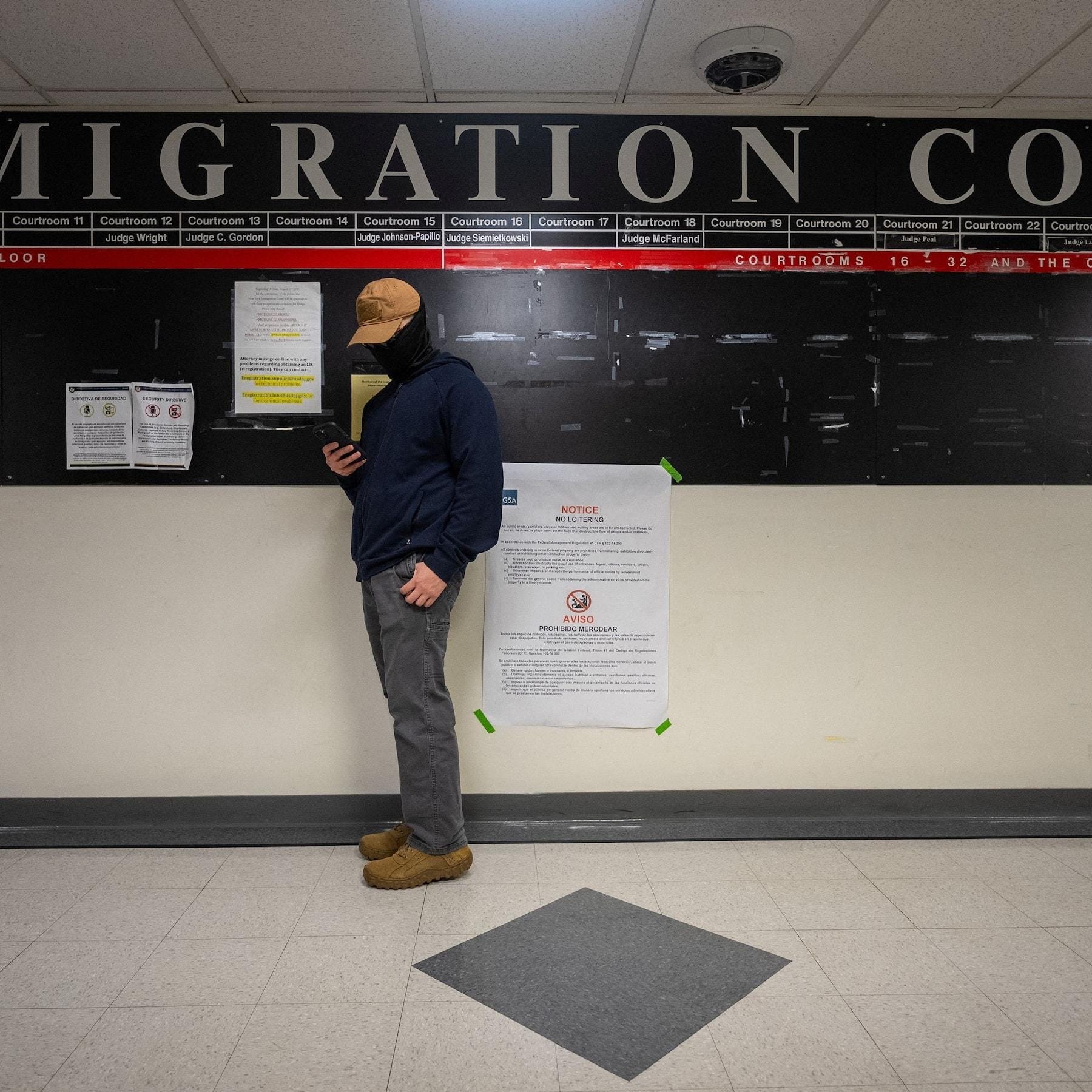
Inside an immigration court.
At the same time, the immigration courts are being pushed in the opposite direction.
More than 100 of roughly 700 immigration judges were fired or pushed out in 2025. The remaining judges face pressure to clear cases faster — even as the administration accuses the courts of pro-immigrant bias.
The immigration courts have become a deportation rocket docket.
One judge reportedly handled 143 cases in a single day.
Delay when the goal is exclusion.
Speed when the goal is removal.
Project 2025 did not invent that logic, but it gave it a governing framework: treat humanitarian protections with suspicion, expand executive discretion, and make immigration enforcement the organizing principle of the system.
That is not vetting.
That is paralysis dressed up as security.
ProPublica and Documented later obtained Project 2025 training videos showing that the project was not merely a policy document but also a personnel and implementation operation, including training for future appointees on how to govern, staff agencies, and confront the career bureaucracy. See Andy Kroll and Nick Surgey, “Inside Project 2025’s Secret Training Videos,” ProPublica, Aug. 10, 2024.
Great post. I have been thinking along these same lines.
Orban’s Hungary was always the template for Project 2025. Win once, rewrite the rules so the state becomes a spoils machine that is loyal not to law or competence but to a single leader and his faction, then lock it in so it can never change.
The blueprint talked about shrinking government, but really it was about breaking the distinction between neutral civil servants and political appointees. Thousands of experts could be converted into at‑will “Schedule Policy/Career” loyalists or forced to resign. Musk's idiots added another layer by burrowing into the databases and stealing the private information of millions of people, and the repercussions of this crime have yet to surface.
It is classic Orbanization to delegitimize professionals as a “deep state,” strip their protections, and replace them with cadres who will execute whatever the executive wants, regardless of long‑term damage. Often these people are incompetent and have no experience in the field, but are arrogant and cruel. This incompetence is what will bring them down, but not right away.
This is because systems still have to deliver to the people they claim to represent, and they’re so fucking bad at it. When refugee policy becomes “racial and political preference with refugee paperwork on top,” even the favored groups eventually discover they’ve inherited a gutted apparatus that can’t actually help them.
When courts, unions, and a few stubborn institutions survive, the gap between the strongman myth and everyday reality becomes impossible to hide. Add to this the massive economic damage incurred by those at the bottom, it becomes increasingly difficult to shift blame. Fox may tell you prices are going down, but choosing between a loaf a bread and a tank of gas is the reality for a lot of people now. And don't get me started on medical debt.
The failure to deliver was why Orbán faced a public capable of saying “enough." This American imitation will ultimately meet the same fate once voters stop asking “Did you punish the enemies I hate?” and start asking “Did you make our lives better?”, the plebiscite they tried to rig will take them down.
But this time there needs to be consequences. Prison for the perpetrators---but that's a huge subject, because post-revolutionary fervor for perceived justice has usually led to blood in the streets, and the inevitable rise of an even worse tyranny. Look at the American south, or post-Nazi Germany, look at revolutionary France or Cuba or the Bolshevik revolution. Those who cannot remember the past and all that.