
The Hostile Takeover — The Project 2025 Chronicles, Vol. VI
A blueprint becomes a government at blinding speed — I spent eleven years inside the systems it’s taking apart.


They wrote the blueprint. He said he’d never heard of it. Many now hold the most powerful positions in the U.S. government.
Donald Trump spent the 2024 campaign insisting Project 2025 had nothing to do with him. The Heritage Foundation — the organization behind it — boasts that the Trump administration has now implemented 53 percent of the blueprint in barely eighteen months.
And it reads like a countdown to the end of the constitutional republic.
Volume I traced the blueprint, the people now carrying it out, and how it is reshaping the federal workforce, refugee program, asylum system, and immigration policy.
Volume II followed one piece of that blueprint from first-term asylum policy to a deportation plane that landed in one of the most dangerous countries in the world.
Volume III turned to Ukraine: the country where I served as a Peace Corps volunteer, and the country whose survival Project 2025 reduces to presidential discretion.
Volume IV turned to Article III of the Constitution: the Court.
Volume V turned to the Constitution itself.
The sixth and final installment turns to the hostile takeover of the American government.
VOL VI: The Hostile Takeover
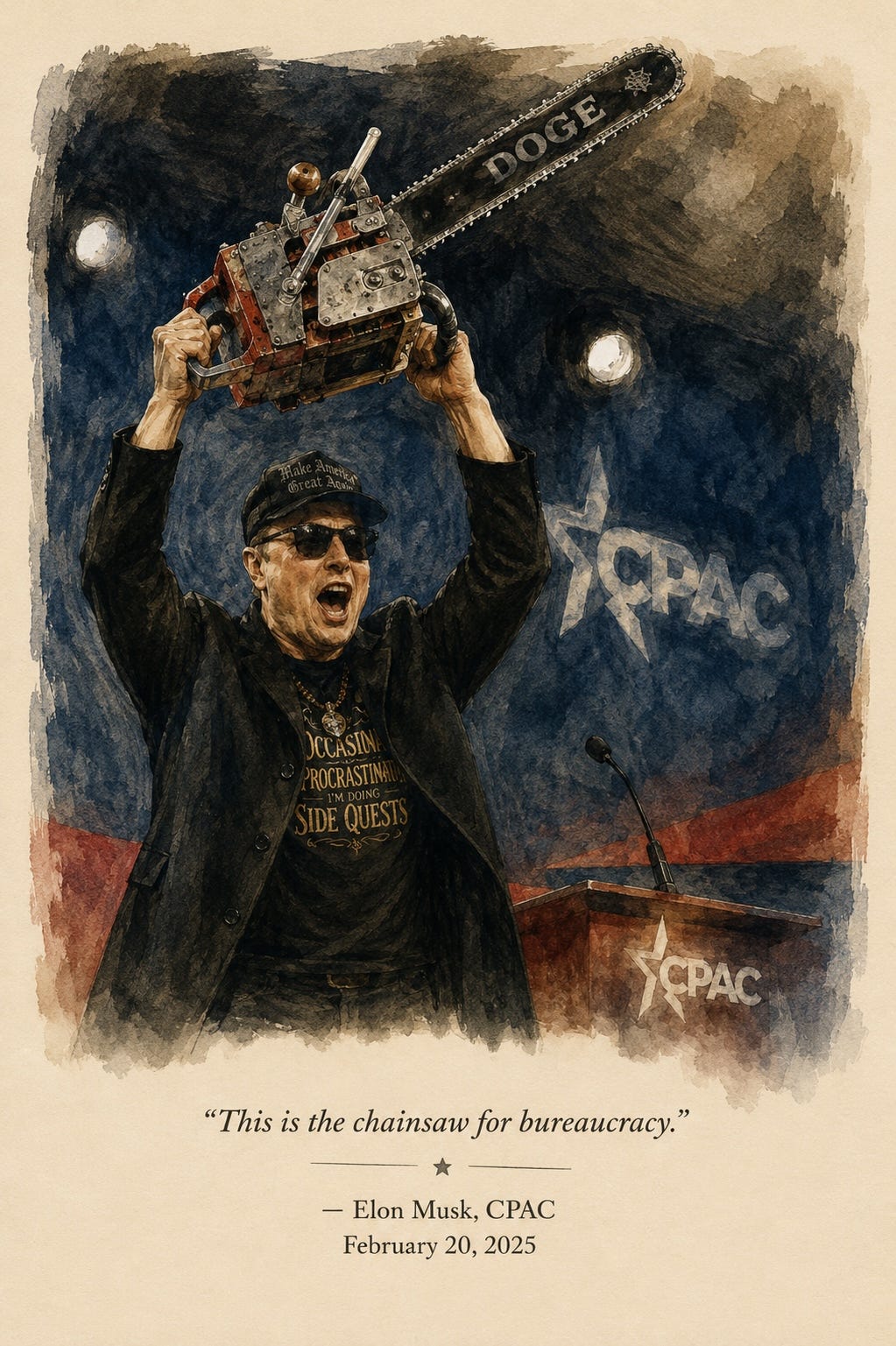
On July 4, DOGE’s formal mandate ended.
The chainsaw is going back in the shed.
Just as the agencies it tore to shreds begin hiring again.
They were so committed to eliminating waste that one of the first items on the agenda was spending billions of taxpayer dollars to pay tens of thousands of experienced civil servants not to work.
Those agencies are now scrambling to fill the vacancies.
The State Department. The IRS. Health and Human Services. Social Security. The Department of Education. The Cybersecurity and Infrastructure Security Agency. The National Endowment for the Humanities. Agency after agency, scrambling to replace the very people it paid billions of taxpayer dollars to push out.
The jobs did not disappear.
The civil servants did.
The “E” in DOGE stood for EFFICIENCY, after all. Turns out chainsaws can be remarkably efficient—at destruction.
So now they’re calling it “reshaping.”
In the first five months of this year, the federal government posted more than 104,000 job openings—far more than during the same period last year. The “Fork in the Road” program alone reportedly cost taxpayers an estimated $11 billion to pay federal employees not to work.
It started with an email.
The subject line read:
Fork in the Road
It came from an unfamiliar email address.
Most of us assumed it was a phishing attempt.
Many followed their training and reported it as such. Others warned coworkers not to click the links.
Then another message arrived. This one came through an official government email. Same message.
It was presented as a voluntary resignation offer.
The messages that followed made clear what it actually was.
Go take a paid vacation, they said. Find something better to do with your time than serve the public. Get a real job in the private sector was the clear message.
Russell Vought, one of Project 2025’s chief architects and now director of the Office of Management and Budget, had promised that bureaucrats would be “traumatically affected.”
This was how it began.
Not metaphorically.
Institutionally.
The End of an Independent Civil Service
In Volume I, my old job was on the list.
The list is now in force.
And last week, the administration confirmed it is looking for more names to add.
The first roughly 8,000 positions were concentrated near the top of the career workforce. Now the administration is considering reaching further down, potentially into thousands more positions.
“This is probably not like a single thing,” OPM Director Scott Kupor said.
He was right about that.
Schedule Policy/Career is not merely another personnel category. It moves career employees outside the ordinary civil service removal system and into at-will positions with sharply reduced protections against dismissal. The administration describes those positions as sufficiently connected to policy that they should remain under White House control.
My position less than a year ago—Supervisory Refugee Officer—was never a political appointment, never a policymaking job, and never one that changed with administrations. It applied U.S. immigration law to refugee cases.
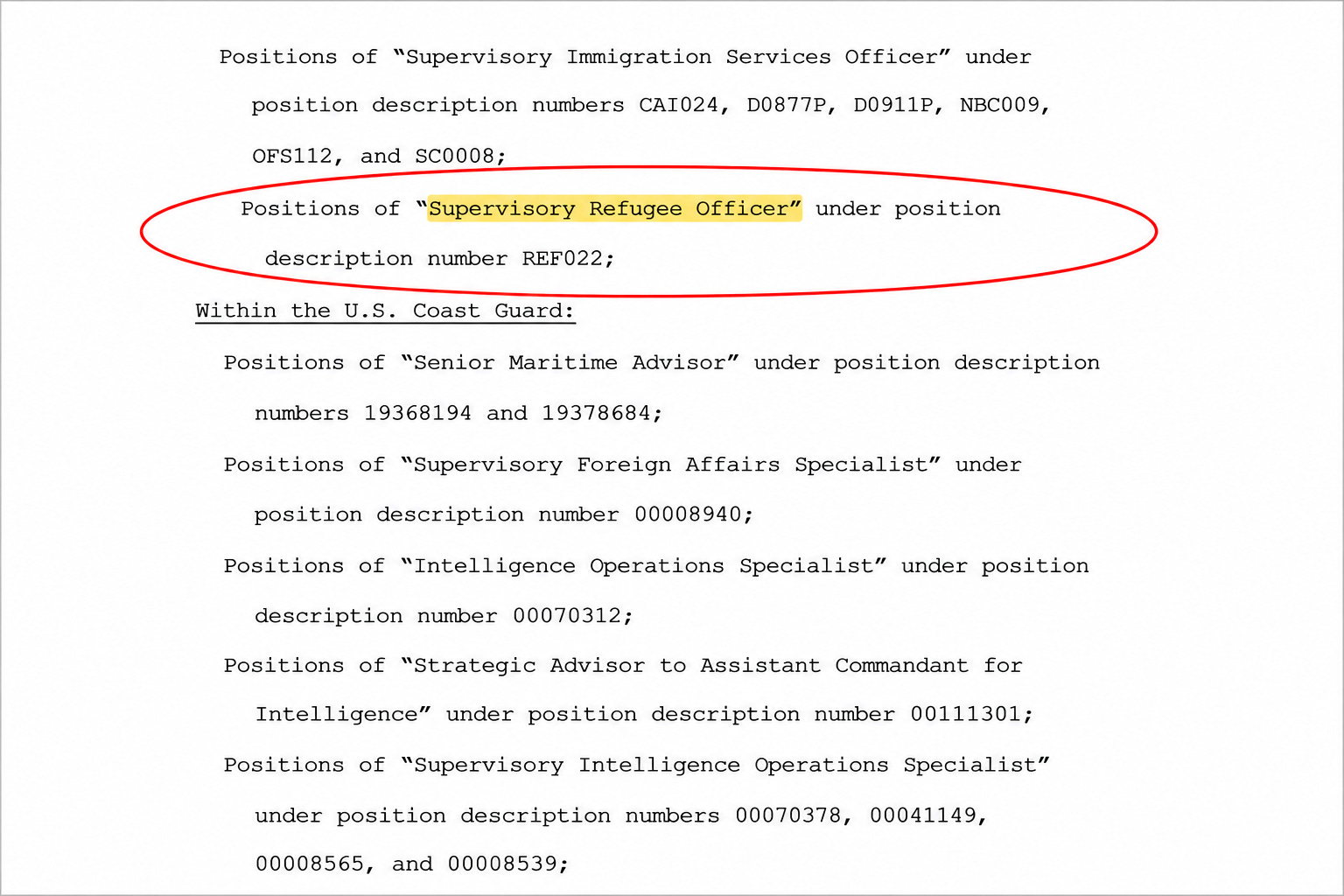
The administration’s Schedule Policy/Career appendix identifying Supervisory Refugee Officer positions for conversion to at-will status.
Yet it was on the list.
The independent civil service is grounded in the principle that federal employees swear an oath to support and defend the Constitution—not to any President. It was designed so that professional judgment, legal obligation, evidence, and expertise would not yield to presidential whims.
Its protections were never a promise of lifetime employment.
They were a promise that government service would not become political patronage.
Merit instead of loyalty.
Law instead of personal obedience.
A professional civil service instead of the spoils system the country spent more than a century trying to leave behind. A system that treated public office as political currency—jobs for loyalists, favors for allies, and government power in service of the people who controlled it.
Project 2025 supplied the constitutional theory and the personnel machinery.
Musk brought the chainsaw.
And DOGE took it further than even its architects may have imagined.
That Private-Sector Efficiency I Always Heard About

The most radical transformation of the American government in generations. Literally named after a joke.
Some facts are worth stating plainly, because they sound invented.
DOGE stood for the Department of Government Efficiency.
It was named after a cryptocurrency.
Which was named after a meme.
Which was a picture of a dog.
The most aggressive restructuring of the federal workforce in a century took its name from a Shiba Inu meme whose captions said things like “much wow” in broken English.
Musk had spent years pumping the coin.
Now he had the government to match.
DOGE said it was saving a billion dollars a day.
The number kept changing. The receipts kept not arriving. Every time a reporter checked the math, the savings shrank.
But the billion-a-day headline had already done its work.
The method wasn’t new either. He’d run it before.
When he bought Twitter, he opened with mass layoffs and an email telling employees to commit to “extremely hardcore” work or take the door. The subject line was “A Fork in the Road.” Most took the door. More than a thousand who stayed were fired anyway—some the night before Thanksgiving.
The lawyer who sued him over it watched the federal version land and pointed out that he hadn’t even bothered to write a new subject line.
He did drop the “A.”
Those same four words hit two million federal employees. Fork in the Road.
Then came the sequel: reply with five bullet points on what you did last week, or be counted as resigned. He’d done that one at Twitter too—made engineers print their code and defend it to his face.
He was recycling one hostile takeover for another. We were the reboot.
Then came the people sent to do it.
Nineteen- to twenty-five-year-olds. No government experience. Handed the keys to federal systems most career employees spend years earning their way toward.
The most famous was nineteen. He went by “Big Balls.”
Not a leak. Not something an enemy dug up. He had put it on his own LinkedIn. As a joke.
Not sure how my background investigation would’ve gone under an alias like that.
They gave him access to the National Finance Center—the payroll and personnel system for the Justice Department, DHS, and the FBI. From there he collected roles at the State Department, DHS, FEMA, USAID, and Social Security.
A former FBI agent said he wouldn’t have recommended the kid for government work at all. Records later showed that a company he operated had provided technical support to a cybercrime network.
They gave him the keys to the vault anyway.
The “E” Is for EFFICIENCY
At USCIS headquarters, the signs of the new order were hard to miss. Cybertrucks began appearing in the best spaces in the parking garage. I would pass them on the way upward, circling toward whatever space remained, while employees inside wondered whether that would be the day the next email arrived—or the day their jobs disappeared.
The symbolism was almost too perfect.
Career civil servants who had spent years mastering complex government systems—along with senior officials responsible for running agencies and divisions—were waiting to learn whether they would still have jobs. At the same time, Musk-aligned operatives were being ushered into agencies and sensitive systems in the name of finding waste.
And yet we knew almost nothing about what they were doing. They had access to extraordinary amounts of information about us.
Classification and access controls are not bureaucratic theater.
They exist because the government holds information that can expose intelligence sources, military operations, diplomatic communications, law-enforcement investigations, proprietary business information, and the most sensitive details of people’s lives. In immigration systems, that can include asylum narratives, biometric records, medical histories, family relationships, security-check results, and information that could place applicants or their relatives in danger if improperly disclosed.
I know because I went through the process myself. Even after years in federal service with an active security clearance, an upgrade to a higher level still took roughly six months, another background investigation, interviews, and formal adjudication before additional access was granted.
That is how seriously the government was supposed to treat sensitive information.
Then DOGE arrived.
They were inside the databases before most civil servants got their drug test results back.
The rules became optional.
Then again, the president who put them in charge had already stored classified records in a Mar-a-Lago bathroom and had shown a classified military attack plan to unauthorized people.
Musk spent $288 million to help put him back in office.
Apparently, that is the price tag.
Lobbyists pay for access to government officials.
Musk was given access to the government itself.
DOGE was the opening phase of a hostile takeover: drive out the people who understood the institutions, strip away the protections that allowed them to resist, seize the systems and data they guarded, and redirect public power toward private and political interests.
Musk did not merely gain influence over the government. He gained access to the actual systems used by agencies that contracted with his companies, regulated them, investigated them, and enforced the laws governing them.
His businesses had received at least $38 billion in government contracts, loans, subsidies, and tax credits. SpaceX alone held roughly $22 billion, primarily through government contracts. Yet DOGE sought or obtained access inside agencies overseeing Musk’s contracts, bids, regulations, and investigations.
Who needs lawyers and lobbyists when the president lets you inside the computer?
Projection as Confession
Contrary to some people’s apparent belief, shouting the word fraud does not make it true.
It requires a bit more to have any legal meaning.
At its core, fraud involves a material lie or concealment, knowledge or reckless disregard of its falsity, an effort to induce reliance, and resulting harm. The exact elements depend on the claim or statute, but accusation alone has never been one of them.
DOGE couldn’t be bothered with any such formalities.
It replaced any semblance of a legitimate fact-finding mission with the sound of a chainsaw.
An unused credit-card account became evidence of theft.
I cannot speak for every corner of the federal government. But I spent eleven years in USCIS divisions that deployed and trained thousands of officers across the United States and around the world.
I carried a government travel card for years. Official travel had to be authorized in advance. Per diem rates were set. Every charge had to be accounted for. Every receipt had to be submitted. You could not upgrade yourself to business or first class. Delinquencies, down to the dollar, were visible up the supervisory chain. Cards could be suspended or canceled.
Employees could face serious consequences.
An unused account proved nothing.
The verdict came first.
The evidence was promised later.
Meanwhile, “Big Balls” was inside secure government systems containing some of your most sensitive data.
“This is the chainsaw for bureaucracy,” Musk declared as he held it above his head at CPAC.
It made for a great photograph—for a WWE event.
Trump spent the campaign insisting he knew nothing about Project 2025.
Then he handed Musk the chainsaw and made him the face of the destruction.
Musk delivered something of a fantasy for the project’s architects: the federal government dismantled at lightning speed, their blueprint accelerated with impunity, and, by Heritage’s own accounting, more than half of Project 2025 implemented in barely eighteen months.
If anyone ever performs an autopsy on DOGE, its method may reveal the precise anatomy of the fraud it claimed to be hunting: sweeping material claims, reckless indifference to whether they were true, a public asked to rely on those claims, and immense harm once it did.
Perhaps someone just needs to shout it loudly enough. Maybe a larger power tool.
The operation that demanded receipts from everyone else is shutting down without producing any of its own.
Asked whether the administration would account for all that efficiency and what DOGE had done—the dollars, the jobs, the cost—the man who now runs the federal budget had an answer.
That man is Russell Vought. He runs OMB—the nerve center of the president’s budget and management agenda, and the office that would have to produce the receipts.
Oversight is not on the agenda.
The architect of the blueprint, auditing the demolition he designed, has decided there is nothing to report.
We’ll probably never know what DOGE actually cost the American taxpayer.
But we know what it did.
It paid tens of thousands of experienced civil servants not to work.
It drove career experts out of government and then began recruiting people to fill many of the same jobs.
It dismantled the world’s largest government foreign-assistance system and interrupted programs delivering food, medicine, disease surveillance, and protection to millions of people.
Then it kept going.
It entered systems holding the private information of nearly every American. It moved Social Security data through an unauthorized server—the most sensitive records the government keeps, routed outside the controls built to protect them.
It eliminated offices, abandoned projects, erased institutional memory, and scattered expertise accumulated over decades.
It crushed unions, appeal rights, whistleblower protections, and institutions designed to keep professional public service independent of immediate political control.
It redirected public machinery toward political priorities and private interests.
It invented an affirmative-action program for white South Africans and repurposed the crown jewel of America’s humanitarian protection system to carry it out, while tens of thousands of refugees from around the world remain shut out.
It stood up an Office of Remigration to run deportations through the same system that offered refuge to millions over decades—cutting deals with some of the most dangerous countries on earth to take the people we are now sending back.
Volume II followed one deportation plane to one of those countries.
Remigration is that plane, now a fleet.
Hundreds of thousands of Venezuelans have already lost their protections, even as their country is still pulling bodies from the rubble of catastrophic twin earthquakes. And after the Supreme Court cleared the way for the administration to terminate TPS for Haiti and Syria, hundreds of thousands more now stand one step closer to a removal order and a plane ride back into grave danger.
While the carnival barkers shout about Haitians eating cats and dogs, the Project he swore he’d never heard of is rewriting who counts as an American, who the government works for, and who gets put on a plane.
To places where you are told to leave a DNA sample behind so your family can identify the body.
And when the cutting stopped, agencies discovered that the work had not disappeared.
Across the government, agencies are hiring again for the same jobs they paid experienced civil servants billions of taxpayer dollars not to do only months earlier.
Some have returned as contractor roles. Many of the people who already knew how to perform the work have not been brought back.
We can count some of the employees fired.
We can count some of the jobs now being filled again.
We can count some of the programs abandoned and some of the expertise driven out.
But the full cost of dismantling institutions built over generations, across nearly every function of the federal government, may never be measured.
The cost to America—incalculable.
The Court Completes the Takeover
Volume IV traced how the Court had been built to clear the path.
As its term ended, it delivered.
The administration’s reclassification of thousands of protected civil-service positions—including my former job—into at-will policy roles ripples downward through the federal workforce.
The Supreme Court’s recent removal decisions reach upward into the leadership of independent agencies across the federal government.
In Trump v. Slaughter, the Court held that statutory protection preventing the President from removing an FTC commissioner except for cause violated the separation of powers. The majority’s theory was direct: officials exercising executive power must remain subject to presidential supervision and removal.
Make career employees much easier to fire.
Bring independent agencies under tighter presidential control.
Crush the unions and outside appeal rights.
Subject career officials who raised legal or ethical objections to forced reassignment, threats of termination, and hours-long polygraph examinations.
Place hiring and firing under tighter White House control.
In Trump v. Cook, the Court preserved the practical force of the Federal Reserve governors’ for-cause removal protection, rejecting an interpretation that would have reduced it to at-will employment. The Court emphasized the Fed’s distinctive history and the importance of protecting central banking from political interference.
The markets still require institutional independence—for now.
That “for now” is the whole story.
On the civil service, on presidential removal, on the machinery of executive power, the Court gave them almost everything Project 2025 assumed it would.
And what little the Court won’t hand over, they assume they can work around. Volume V was about exactly that—constitutional red lines treated not as walls but as inconveniences to be routed past. Birthright citizenship could not be ended by executive order, so they signed one anyway and assumed the Court would give them that too. The Fed could not be seized without burning down the economy, so the pressure shifts instead—to rates, to appointments, to the next vacancy.
Citizenship. The merit-based civil service. Two nineteenth-century protections, now provisional.
Apparently, we finally have an answer to when America was “great.”
The nineteenth century is making a comeback.
What Was Never on the Ballot
For six volumes, I have traced what this looked like from inside the systems being taken apart.
Fifty-three percent, by Heritage’s own count, in eighteen months.
It only accelerates from here.
Every major lever has been captured and is pulling in the same direction. The workforce, purged and made at-will. The courts, pre-positioned to clear the path. Congress, taking its marching orders from the White House. The watchdogs, defunded. The data—on citizens, on immigrants, on nearly every American—inside systems the executive now controls end to end.
One branch reaching into all the others. One office deciding who counts as a citizen, who the government serves, who gets investigated, who gets deported, who gets paid.
Almost none of it was on a ballot. After all, the president spent the campaign insisting he had nothing to do with Project 2025.
No one voted to hand "Big Balls" access to the payroll systems serving the FBI, DHS, and the Justice Department.
No one voted to run deportations to the Central African Republic, one of the most dangerous countries on earth, through the system built to offer refuge.
No one voted to send hundreds of thousands of caregivers, business owners, workers, and neighbors—people who were here lawfully and did everything the system asked of them—back into grave danger.
No one voted to fast-track white South Africans while vetted and approved refugees get locked out.
No one voted to end the independent civil service.
Volume V argued that the guardrails can only hold if the people in power operate in good faith.
This administration has learned that no one can make them.
Separation of powers is treated as an inconvenience.
The Constitution, as something to work around.
Security clearances, as paperwork for lesser people.
Power, as something to seize by any available means.
People this committed to holding power do not give it back. Not when they’ve built the machine to keep it. Not when every check has been captured or hollowed out. Not when they’ve dismantled the machinery meant to hold them accountable.
The chainsaw is going back in the shed.
The machine it built is just getting started.