
The Deadline That Was Never Supposed to Catch Them
There is an obscure rule that decides whether a person can pursue asylum in the United States. I spent years applying it. A new plan would turn it into a wall.

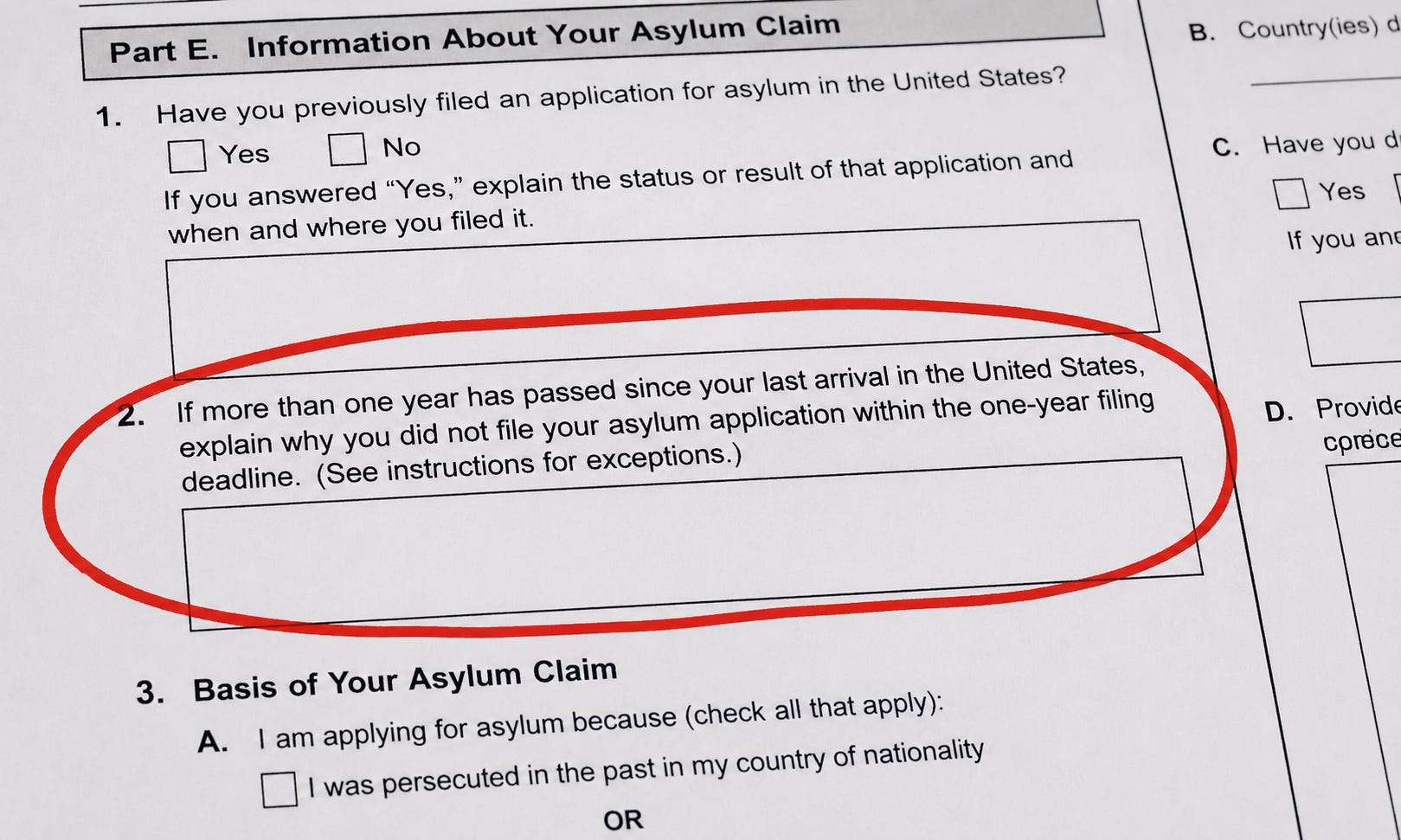
I-589 (Application for Asylum and for Withholding of Removal)
Years ago, I interviewed a Yemeni woman seeking asylum.
She had never lived there. Raised in a third country that did not recognize her as a citizen, she had come to the United States lawfully, as a student, with no asylum claim to make. She was in status. She was not fleeing anything. She was here to study.
Until her status lapsed. If she couldn’t remain in the United States, she would be removed to Yemen — a place she had never set foot in, now consumed by war, and among the most dangerous places on earth to be an educated woman.
Before we could talk about any of that — before I could ask a single question about what she feared — there was a threshold problem in front of us.
She had filed for asylum more than a year after she arrived.
The one-year filing deadline.
Most Americans have no reason to know the machinery of America’s asylum system. They do not know that a person generally has only one year after arrival to apply for asylum, or that missing that deadline can prevent the government from ever reaching the question at the heart of an asylum case: whether the person actually fears persecution.
This week, CBS News reported that the Trump administration is developing a regulation that would let asylum officers reject certain late-filed applications without an interview, sending those applicants straight into removal proceedings before an immigration judge. The administration frames it as a way to clear a backlog of more than a million cases — to stop, in the words of a USCIS spokesperson, “wasting time” on applications it would refer to court anyway.
On its face, that sounds reasonable. The backlog is real. Some people do file years after arriving, with nothing that would excuse the delay. Congress imposed the deadline for reasons that were not imaginary.
But to understand what this proposal actually does, you have to understand how the asylum system was built — and what the interview was for.
Two Doors Into the System
There are two ways to pursue asylum in the United States, and they are very different experiences.
The affirmative system is for people who are already in the United States — most often because they entered lawfully on a visa or some other status — and file an asylum application directly with USCIS, the benefits agency. It grew out of the asylum corps created in the early 1990s, and it was designed to be non-adversarial: an applicant sits down with an asylum officer, explains their case, and the officer — acting as both fact-finder and decision-maker — determines whether they qualify. No opposing counsel. No courtroom. If the officer grants the case, it is over. If not, USCIS issues a notice to appear in immigration court, informing them they are now in removal proceedings.
Defensive asylum is different. That is asylum claimed by someone who is already in removal proceedings. It can also include people placed into removal proceedings after crossing the border or arriving at a port of entry and expressing a fear of return. The case is before an immigration judge. There is an ICE attorney whose job is to oppose you. There is a judge with a staggering docket. It is litigation, with appeals, conducted while you are fighting to remain in the country.
The proposed rule takes a category of applicants who would normally begin in that non-adversarial process and moves them directly toward removal proceedings — without the interview that has traditionally determined whether they meet one of the exceptions to the one-year deadline.
How the Deadline Works
The one-year deadline entered the law in 1996, as part of IIRIRA — the sweeping enforcement act often called the last major immigration reform Congress actually passed. Every comprehensive attempt since has collapsed. So this rule, and the bargain inside it, has stood for nearly thirty years.
The concerns behind it were real ones. Congress worried about delay, about fraud, about people filing years after arrival with no genuine claim, about an affirmative backlog that never emptied.
Those were legitimate worries.
But Congress also understood the obvious problem with a hard deadline: real asylum seekers do not always know they have an asylum claim within a year of arrival. Some are here lawfully. Some are still hoping conditions will change back home. Some are too traumatized or medically vulnerable to come forward right away. Some develop a claim only after something happens abroad or in their own lives. So Congress did not create a strict liability bar. It created a deadline with narrow exceptions — and then made applicants prove those exceptions by clear and convincing evidence.
The rule is simple to state. To be eligible for asylum, you generally must apply within one year of your last arrival. File late, and you are barred — unless you can establish one of two exceptions: changed circumstances that materially affect your eligibility, or extraordinary circumstances that explain the delay.
And once you have filed late, the burden is on you, and the standard is demanding. You must show by clear and convincing evidence that an exception applies and that you filed within a reasonable time once it did. Not knowing about the deadline is not enough. Struggling to find a lawyer is not enough. Your home country deteriorating, in general terms, is often not enough. You have to fit inside one of two narrow statutory exceptions and prove it to a high standard.
The Bar to Be Heard is Higher Than the Bar to Win
To win asylum on the merits, you must show a well-founded fear of persecution — a standard courts have read as a reasonable possibility, something well short of certainty. But to get past the one-year filing deadline, you must present clear and convincing evidence, a markedly higher bar.
So the threshold to be heard is higher than the threshold to prevail. A person can hold a strong asylum claim — real persecution, solid country conditions — and never have it examined at all, because the deadline is a gate, not a factor weighed in the balance. If you filed late and cannot establish an exception, the merits become irrelevant.
Many applicants fail to meet those exceptions. Some claims are weak. Some are frivolous. Some are exactly the sort of delayed filings Congress worried about when it created the deadline. The rule was designed to screen those cases out.
But others are different. They may genuinely fear return. They may ultimately qualify for asylum. Yet if they cannot prove that one of the statutory exceptions applies, the government never reaches the question of persecution in the first place. The case turns not on whether the fear is well-founded, but on whether the applicant can clear the threshold required to have that fear even considered.
What the Interview Was For
The asylum application already asks late filers to explain why they missed the deadline. In practice, that space on the form was the beginning of the inquiry, not the end of it.
I interviewed applicants whose claims had not existed when they arrived in the United States. One had come lawfully, with no reason to seek asylum. Years later, after a serious medical event, he faced return to a country where life-saving treatment was limited and the diagnosis itself carried severe stigma. The legal question came down to when the diagnosis arose, whether that change materially affected his eligibility, and whether he filed within a reasonable time afterward.
That is what changed circumstances can mean. Not a loophole. A claim that comes into being after the deadline has already run.
The interview was where the real determination happened. It was where an officer developed the facts: when, exactly, the circumstances changed. Why the person waited. Whether the change actually affected their eligibility. Whether the delay, given everything, was reasonable. These are questions that require more than a box on a form, especially when the law itself demands clear and convincing evidence.
Take a case like the Yemeni woman from the opening.
On paper, her explanation might fit in a few lines. I came as a student. My status lapsed. I cannot return to a country I have never lived in, now at war, where women like me face serious danger. But the facts underneath those lines — the country of nationality she had never actually lived in, the country where she had spent her life but had no right to remain, the lapse in her lawful U.S. status, the timing of when return became dangerous, whether she had moved within a reasonable period once it did — none of that fits in a box. It had to be developed. That is what the interview was for.
What the Rule Changes
According to the CBS reporting, the regulation would let officers issue quick rejections “where the paper record suggests the applicants did not meet the 1-year deadline.” Officers could still schedule an interview, the documents say, in cases where an exception appears to apply.
Read that carefully, because it contains the whole problem.
How does an officer determine, from the paper record alone, whether a demanding statutory exception has been met — using a process that deliberately removes the interview that exists to make that determination? The exception turns on facts that only emerge when you ask. A paper record can tell you that someone filed late. It cannot tell you, in most real cases, why — not to the clear and convincing standard the law requires. The rule asks officers to spot the exception without the tool built to find it.
The Honest Version of the Other Side
I am not going to pretend the system is fine. The backlog is real and crushing. Some late-filed applications plainly do not qualify, and never will. Some people do file years after arrival with no legally sufficient reason, and an interview in those cases confirms what the file already shows. There is surely room to make parts of this process more efficient.
The question is where you draw the line — and whether a checked box and a few lines on a form are an adequate substitute for the one step that, for decades, actually determined whether the exceptions applied.
Congress knew, when it wrote the deadline, that legitimate refugees would sometimes miss it. That is precisely why it built the exceptions in. The bar was the concession to enforcement; the exceptions were the concession to reality. The two were a package, and the package was the deal.
This proposal does not repeal the exceptions. It can’t — that would take Congress, and Congress has not passed major immigration legislation in thirty years.
The exceptions remain in the statute, exactly where they have always been — while the principal mechanism for establishing them disappears.
For the woman who sat across from me that day, the difference was not abstract. Before anyone could decide whether she had a well-founded fear of persecution in Yemen, someone first had to decide whether she could pursue her asylum claim at all.
Under the new rule, that decision could be made before she ever has the chance to explain it.
There is still a box on the form for that.
Examples in this essay are drawn from the author’s experience; identifying details have been changed.
Loved this post -- I had a lot to say about "Exceptional Circumstances" and the OYFD here:
https://samsramblingss.substack.com/p/that-darn-seattle-traffic